Find Your Niche: The Power of Keyword Research For Awesome Content
Most effective SEO strategies begin with keyword research, but to a lot of content marketers, it can feel like a daunting task. However if done correctly, keyword research can drastically improve your content’s rankings and bring you not only increased traffic, but also the right kind of traffic.
In this blog we’ll explain some important facts about keyword research, and show you the steps to identifying the best keywords for your content.
How to find niche long-tail opportunities with keyword research
Head terms vs. Long-Tail
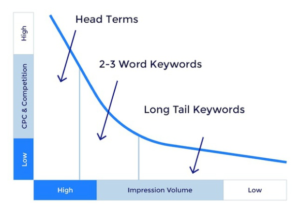
The first thing to understand when it comes to keyword research is that there are different types of keywords. The two main types are head term keywords, and long-tail keywords.
Long-tail keywords are longer, specific keyword phrases that users tend to type into the search engine when looking for an answer to a specific question, or a solution to a specific problem. Head term keywords are short, often one-word keywords that can be very broad in nature.
(Source: https://www.quora.com/What-is-Head-Terms-Keywords-Vs-Long-Tail-Keywords)
Broader keywords have higher search volumes which can mean increased traffic, but they also come with greater competition and are harder to rank for. More niche, long tail queries have lower search volumes, but they are a great source of qualified traffic and they are easier to target. Additionally, as their form is longer, there is almost an infinite number of long tail queries to target.
This is why long-tail queries should definitely be a part of your SEO strategy. At scale they can be very rewarding as they’re easier to gain traction with and you will be able to target a much more niche, qualified audience who should be further down the sales funnel.
Keyword search intent
As well as keyword types, you should be aware of keyword search intents. When a user enters a query into the search box, the search engines will try to understand their intentions, and provide results that will be relevant to that intent.
Hence when you select your keywords, especially the long-tail ones, you should consider the search intent of each one. This will help you ensure that your content is targeting the right phrases and will answer your customer’s needs effectively.
Keyword search intents can be categorised as follows:
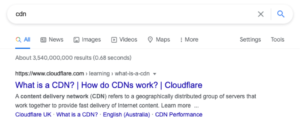
- Information – this is commonly the intent of broad, head term keywords like ‘cdn’ or ‘trainers’, as well as ‘what is’ type queries, like ‘what is a cdn’ or ‘what is kombucha’. The results ranked highest in the SERP will be informational content, often including wikipedia.
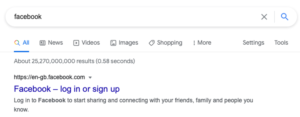
- Navigational – this is often applied to branded terms, when users are trying to navigate to a page e.g. ‘Facebook’ or ‘tsb’. Most results will be direct links to brands’ websites.
- Transactional– these are more likely to be long-tail queries, where users are looking to purchase something. Examples include ‘best cdn provider’ or ‘kombucha sellers near me’. The results here will be more commercially focused.

How to do keyword research for your content strategy
Pick your core target keyword
Now you understand the different types of keywords and search intents, you should start by picking your core target keyword.
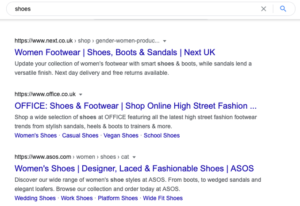
So ask yourself what’s the core topic or product you wish to target? For example if we were an online shoe retailer, our core topic would be ‘shoes’. Now this is a head term keyword – it’s broad and has a high search volume (201,000 monthly searches in the UK). But if you type in ‘shoes’ into Google right now, the competition is fierce with well established brands ranking on page one. So creating content to rank for this broad head term keyword alone could potentially be wasted effort unless you’re already a well established market leader in your industry.
So now you have your core topic keyword, you need to look for keywords related to your topic, but which will allow you to expand a little.
Find your related keywords
Use keyword research tools, like Google’s Keyword Planner, to build a list of 2nd level keywords related to your core keyword and its variations. Following our example, we could identify ‘red shoes’, ‘women’s shoes’, ‘high heel shoes’ as related, second level keywords.
Now you have this list of 2nd level keywords, you can start to identify long-tail keywords that can be used in your content pieces. For example you could write a blog about ‘the best shades of red shoes’ or ‘where to buy comfy high heel shoes’.
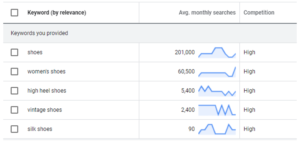
At this stage you can identify opportunities to build sub-categories that you currently don’t have to capture search traffic.
This is also an opportunity to identify what makes you unique and use that in your longer-tail keywords. If you specialise in high-heeled shoes made of silk, look for long-tail keywords that mention this as the people searching for ‘high-heeled shoes made of silk’ are looking for something specific that you provide. Use your niche to your advantage.
Answer your customers’ question
A great tip for really getting into your customer’s heads is to check the ‘People Also Ask’ and ‘Relates Searches’ boxes in Google. The People Also Ask section in the SERP is a selection of questions that other people have typed in, and Google has identified them as relevant to the current query.
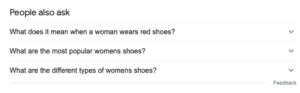
The ‘Related Searches’ box in Google is the suggested phrases that appear when you start to type something into the search box. Again these have been aggregated by Google based on what other people have searched in relation to the topic.

Both the People Also Ask and Related Searches boxes are available for almost every search query and really are a goldmine of long-tail phrases that can be used to build blog or product page content.
And one final piece of advice – always check the search volumes of the keywords you’re targeting. Just because a phrase has a higher number of keywords in it doesn’t mean it will always be more niche. Anthony Atkins from Search Engine Land provides a great example where the longer phrase ‘how to gain weight fast’ actually has a higher search volume than the shorter phrase ‘gain weight’.
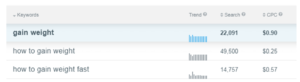
(source: https://searchengineland.com/back-to-basics-what-does-long-tail-keyword-really-mean-311910)
So be aware of this when searching for your target longer-tail keywords and make sure they really are as niche as you’d like them to be.
Now you should be all set to do effective keyword research that uses your niche to your advantage, and can be the foundation for some high ranking content. If you do want any additional support or insights from our team of SEO specialists, get in touch as we’re always happy to help.
Contact our Wakefield based team on 0800 234 3977
Struggling to Get Your Site Ranking? Get in Touch. Need Help Boosting Your Authority? Read on...