Voice search for e-commerce sites
At the Brighton SEO conference in 2019, one of the keynote speeches questioned whether voice search would ever go beyond asking Alexa what time it is, and present a real opportunity for ecommerce sites. Now in 2021, with over 20% of all mobile searches coming from voice search, we think the answer is a resounding yes. So if you do ecommerce, how can you maximise the voice search opportunity?
What is voice search?
Voice search is the technology to enter queries into Google or other search engines, via a voice command, rather than typing in the query into a search box. It’s now possible to make purchases via a voice search assistant, without needing to go near a computer.
The technology behind voice-activated intelligent assistants has progressed rapidly in the last five years, and there are more and more products on the market. Some of the leaders in this field are Amazon’s Echo, Apple’s Siri, Google’s Home and Microsoft’s Cortana.

Amazon is one of the market leaders in voice search technology. Image source: Unsplash.com
Why is voice search important?
The use of voice search is growing year on year. This has been accelerated on one hand by the development of AI and machine learning, which has allowed voice activated technologies to process voice commands and turn them into queries. But on the other hand, it’s the ease for the user that has also contributed to the growth of voice search. Being able to search ‘hands-free’, and speak faster than you would type, makes voice search a quick and convenient way to search as well as a more natural way to phrase searches. Users don’t need to think about how they should phrase a query, they can just say it out loud, as they think it.
Back in 2017, 57% of smart home speaker owners made a purchase using their device. In 2021, that figure is even higher. For e-commerce sites, this presents a huge opportunity: if you can optimize your website for voice search as well as traditional search, you’re reaching every potential audience you can get. Voice search can give your e-commerce site a competitive advantage. If you optimize your site well for voice search, you may be ahead of the curve and can get ahead of your competition.
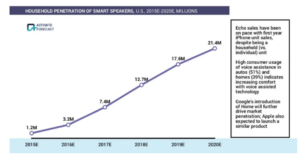
Source: https://www.thesearchreview.com/google-voice-searches-doubled-past-year-17111/
How do I optimize my ecommerce site for voice search?
Voice search recognition from Google has an accuracy of 95% – this means the way marketers are carrying out their SEO work is changing. To optimize for voice search, you should:
- Use Structured data to highlight content for voice search. According to org, the ‘speakable’ rich snippet “indicates sections of a Web page that are particularly ‘speakable’ in the sense of being highlighted as being especially appropriate for text-to-speech conversion.” This highlights text that is suited for voice search and gives the search engine an indication that a specific phrase is there to be used for vocal queries.
- Make sure you use Google My Business and that your listing is up to date. As more than half of vocal searches are made for local products or services, make sure your SEO strategy includes local SEO. For example, as well as targeting your product related queries, also be sure to include location based queries in your target keywords lists.
- Optimize for longer tail queries: when people search via a voice command, they tend to ask things in full sentences (as opposed to one or two keyword phrases in written form). So optimise your content with talking in mind. Think especially about trigger words like: ‘what, who, how, where, when’. For a deep dive into the value of long tail keywords, you can check out our guide.
- Make sure your domain authority is strong: Domains with high authority tend to produce voice search results much more often than non-authoritative domains. Ways to improve your domain authority include working on your backlinking strategy, link building campaigns, auditing your backlinks and removing bad links from your profile, improving your on-page SEO efforts and working on your page loading time.
- Clean up your content and answer questions: remove any duplicate pages and any outdated or irrelevant information. With the content you do have, transform queries into questions. By framing content around questions and answers, for example in the form of a FAQ page, search engines are more likely to process your ecommerce content for responding to voice searches.
So follow our advice and get your site ready for voice search. It’s a step that’s worth taking, and the reward is even more sales from audiences you may not have been expecting. If you would like any help in optimising your e-commerce site for voice-search, get in touch with one of our experts.
Contact our West Yorkshire based team on 0800 234 3977
Struggling to Get Your Site Ranking? Get in Touch. Need Help Boosting Your Authority? Read on...