An SEO guide to Bing
In this week’s SEO blog, we are going to talk about all things Bing. Microsoft unveiled Bing as a replacement for Live Search on May 28, 2009. Soon after Microsoft struck a deal with Yahoo! to use Bing to power Yahoo! Search. Twelve years later Bing has grown to become the world’s second largest search engine globally, behind Google. In spite of this many marketers know very little about how to optimise for Bing. So in this guide we’re going to take a look into what Bing is, why it matters and how to improve your organic performance on this search engine.
Why is Bing important?
Given Google’s dominance of search, it’s important to ask ‘is Bing important?’. The reality is that though Google still has the lion’s share of all searches, slowly but surely, competing search engines, including Bing, are claiming their own share.
Globally Bing accounts for 4.58% of all searches, but if we look a little closer, and combine Yahoo! Search’s share, we see that it accounts for 23.3% of american searches. Globally, Bing registered “1.066 billion total visits across desktop & mobile in September 2021”. Here lies an opportunity to tap into a new audience.
Bing also has the advantage of being cheaper and less competitive. Google advises that it can take twelve months to see any impact from SEO, whereas on Bing, we find many businesses are able to see the difference in a much shorter time scale. As Bing is less competitive, there is lower competition for those coveted top spots.
Bing provides excellent tooling. Tools such as Bing Webmaster Tools Sitemap tool, Bing URL or Content Submission API and Bing Content Removal and Page Removal tools give you greater control of how your website is perceived, and by extension, ranked by Bing. This allows you to speed up Bing’s knowledge of your web pages and results in optimisations being reflected faster in the rankings.
As with all technology, things change and it’s important to keep up to date and stay relevant. As Bing market share grows, optimising for the platform will become more important.
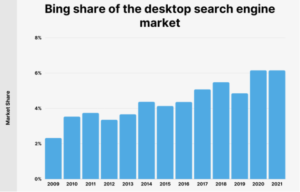
Why Bing is an important search engine to consider (source: https://backlinko.com/bing-users)
How does SEO work on Bing?
Just like Google, Bing ranks search results based on various factors. These factors are often the same on both platforms, which is an additional reason why it may make sense to optimize for both.
User engagement is a vital factor for SEO rankings on Bing and should be a cornerstone of any marketing strategy. User engagement covers a range of activities including total time a user spends on the site or how many comments a user leaves. Pogo-sticker is when users visit your site, but then quickly leave using the back button. This is referred to as the bounce rate. Higher bounce rates lead to low positions whereas sites with higher user engagement tend to rank well on Bing.
Just like Google, Bing assesses click through rates, or CTRs, when determining rankings. Your click through rate is determined by evaluating the number of people who click on your link when presented with your website in ads or search engine results. Your headlines and meta descriptions should be attractive to users and relevant to the content of your page.
Backlinks are another factor that both Google and Bing rank on. Backlinks are links from one external web page to another. Although Google tends to place a greater emphasis on backlinks than Bing, increasingly both value quality over quantity. However one caveat with Bing is that pages without a backlink from at least one external source are often removed from Bing’s index, and therefore don’t appear in any search results. This in fact means that backlinks are fundamental for your web pages if you want them to be ranked at all on Bing. For an in depth guide to backlinks, check out our guide on backlink profiles.
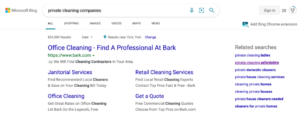
What does Bing check that Google doesn’t when it comes to SEO?
A key difference between Bing and Google is social media. Perhaps as a result of Bing being released in a post-Facebook world, Bing integrates with and places a greater emphasis on social media signals.
Whilst searching on Bing, users are able to see the ratings and recommendations of Facebook friends and Twitter followers directly. It’s of no surprise then that Bing uses this information to inform its ranking: top ranking results have a higher social media presence. This can include tweets, likes and shares.
Multimedia content is another area that Bing prioritises over Google, perhaps another result of it being a younger platform. Including relevant video, picture, and audio content can help boost positioning. Similar to Google, the quality and relevance is important, but unlike Google Bing isn’t as reliant on text based content.
Quick tips for SEO on Bing:
1) Focus your energy on on-page SEO. Though backlinks remain important, especially with the caveat mentioned above, intelligent and relevant keywords are top dog. Make sure to include researched keywords in your page titles and meta data.
2) Bing went to the effort of creating tools specifically for SEO. Use them! Once you’ve updated your website with SEO improvements get Bing to index it. Removed some content? Use Bing Content Removal and Page Removal tools to let them know.
3) You’re probably familiar with Google My business. Bing has Bing places. Go and claim your business on Bing places to increase your local SEO and ensure you appear in local search results.
Hopefully you’re more familiar with the differences between Bing and Google. The good news is that, with a small amount of additional effort, you can benefit on both when optisming for either platform. Remember that although it may not have the market share of Google, Bing still has millions of users. A market well worth tapping into for the shrewd marketeer.