How to choose topics for SEO friendly content
Blogs are often used by organisations as a way to reach users on a wider range of topics than e-commerce pages would allow for. They help you communicate to your target audience useful tips, guides, opinion pieces and interesting insights. Your blog content can also help you rank for a wide range of keywords including longer tail keywords that bring in a more qualified audience. So when it comes to selecting new content topics for your blog, it is helpful to have some SEO strategy behind your selection.
Find topics around your target keywords
The first place to start when it comes to selecting a topic for a blog or other content piece, is the keyword. Now you don’t have to start with the keyword itself, but you should get an idea of what keyword direction you want to go in. There are a few approaches to do this:
1. Use a tool like SEMRush to run a gap analysis
If you’re looking to gain visibility against competitors, a great way to do this is by running a gap analysis report in SEMRush. You can select 1 to 3 competitors, and the tool will show you all the keywords where the competition ranks higher than you. From this you can pick some core keywords to form the basis of your new content pieces.
In the below example, we are comparing site 1 with site 2, and the tool is highlighting in green the keywords where the competitor domain ranks higher in the search results than our domain.
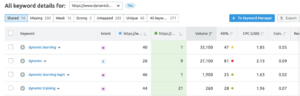
(source: SEMRush.com keyword gap analysis tool)
2. Use keyword planner to find which keywords have high volume and low competition
If you already have a subject matter in mind, or a product range that you are promoting at a particular time of year, you should look into keywords related to that topic and check their search volumes and difficulty scores.
A handy tool to do this with is Google’s Keyword Planner. You can start by typing in some of your ideas and the tool will show you related queries, filtered by search volume and relevance, so you can get insights into how others are searching for these topics.
3. Use Google Search Console to see which queries are bringing traffic to your site already
It is highly recommended to have Google Search Console set-up for your website – this allows you to track your impressions, clicks and average ranking positions over time. The other great thing about Google Search Console is that you can see all the queries that are bringing traffic to your website. You can check this list of queries to identify any new ones that may be relevant to a blog or new content piece.
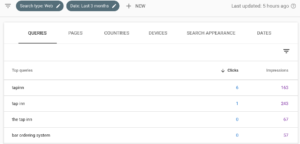
(source: Google Search Console – in performance > queries)
Once you have defined some topics that are worthy of a blog or piece of other content, it’s time to narrow down the specific keywords and user intent of the content piece.
Narrow down the topic based on your user’s intent
There are different types of user intent: people are either looking to find an answer to a question, looking to buy something, or navigate somewhere. The search intentions are: informational, commercial, transactional and navigational.
When it comes to your piece of content – think about whether you want to help someone with a buying decision e.g. commercial intent. Would this piece include the phrasing ‘top ten best…’ or ‘best … for your needs’. If so, you will want to include the words ‘best’ or ‘top’ in your keywords list.
If the user may be looking for information on a topic e.g what something is, how something works etc.. your content should be around informational terms. Phrases to include are ‘what’, ‘how’, ‘why’, ‘who’, ‘when’.
A good way to test if you have identified the correct search intent with your keywords is to type them into Google directly, and see what comes up. The search results will help you understand how Google interprets the intent of the query.
Structure your content with SEO in mind
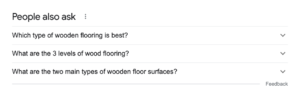
Once you have narrowed down your keyword topics, and then your keyword list, you should think about how you structure your piece of content. A great help with this is the People Also Ask section in Google. This featured snippet is Google’s way of showing users questions that other people have asked in relation to the topic.
These questions in “people also ask” can also be used as long tail keywords that would form the sub-headers in your articles. For example if you were writing a blog on ‘What are types of Wooden Flooring’ – you could take inspiration from the People Also Ask segment to form the subheadings in your article:
For a guide on how to understand entities – check our blog on Entities, Salience and keyword research.
Conclusion:
In order to choose topics for SEO friendly content, you must first narrow down the topics with a range of SEO tools, then you should look at the specific keywords based on the user intent you want to serve, and finally you should structure your piece of content by taking insights from Google and the search results directly.