Entities, Salience and the Future of Keyword Research
In recent years, Google has moved away from keyword centric approach e.g. one keyword per page, and towards an understanding of wider context and topics. This is where entities come into play, and if you want to do SEO well, you should get familiar with this new concept.
How keyword research is changing
With algorithm updates like Hummingbird, where Google started to understand the meaning behind search queries rather than just matching the words to pages, and feature updates like the knowledge graph, a semantic network of related terms, SEO is shifting away from relying on keywords alone. Search engines are becoming smarter and are better able to understand what people want and what people are intending.
We are moving towards something called the semantic web: Google no longer searches for strings of text. Instead it looks at topics and related entities. Search engines can now identify how things relate to each other and the relationship between them, and entities are at the center of this.
What are entities?
Entities are at the core of this new way of searching and serving search results. Google defines an entity as ‘A thing or concept that is singular, unique, well-defined and distinguishable.’
Entities can be discovered by surrounding information – for example the beach can be an entity. Google might understand you’re searching for this entity by surrounding information and related terms in the text like ‘sea, sand, waves, umbrellas etc..’
Google builds knowledge graphs, e.g. semantic networks, that link together entities including objects, people, events, situations and concepts, to build a web of information that it can use to identify topics when people are searching in the engine.
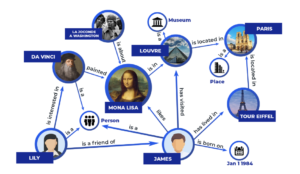
Google uses knowledge graphs to relate entities (image source: https://yashuseth.blog/2019/10/08/introduction-question-answering-knowledge-graphs-kgqa/)
How can I use entities to improve my SEO?
So if entity based optimisation is the new way to improve your SEO, what should you be doing differently?
Choose your topic and primary keyword
When it comes to content, the goal is to strengthen the connection of the main topic of your webpage or blog by relating it to the relevant entities. You want to use context to help users find the information they’re looking for, not just keywords alone. To do this, you should first choose the primary keyword for your page e.g. the keyword you want your page to rank for. Then you will need to discover the related entities, and make sure these are used across your copy.
There is a free tool to do this with: Google’s Natural Language API. This tool uses deep learning technology to process content and extract information about people, places, events, actions and more. The NLP tool will also show you what category a page will belong to e.g. technology, ecommerce, food, medicine etc..
Identify the related entities based on their salience score
When processing content, Google’s NLP tool gives entities a salience score, from 0.0 to 1.0, which measures how relevant entities are to your content.
Once you have identified the top entities related to your content, use these across your copy, with a focus on the entities with the highest salience score. The more you strengthen the relationship between your primary topic and the related entities, the easier it will be for Google to serve your content when people are searching for things related to your page.
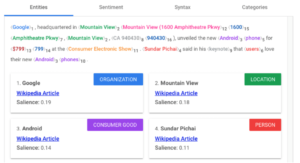
An example of Google’s NPL tool showing related entities and their salience scores.
Entity-based SEO is the future: it’s how Google understands how people search and how it serves results in the SERP. Optimising for entities as well as keywords will give you a competitive advantage in the search results and will make your content richer and better for users.
Contact our Wakefield based team on 0800 234 3977
Struggling to Get Your Site Ranking? Get in Touch. Need Help Boosting Your Authority? Read on...