What is conversion rate optimisation and how can it help your e-commerce site?
If you’re an e-commerce business, winning conversions is probably one of if not your most important KPI. There is in fact a whole body of work around this goal called Conversion Rate Optimisation, so if you want to improve conversions and at the same time increase your SEO performance, then read on.
What is conversion rate optimisation (CRO)?
Conversion rate optimisation is the process of testing and implementing changes on your website to improve conversions. Its foundation is on the principle of continuous testing, implementing, and learning.
CRO works in a circular way where you will first analyse the data on the pages you want to improve, form hypotheses about what changes could improve performance, implement the changes on one version, keeping the other in order to A/B test, then review the results, and the circle starts again. This iterative approach means you will be constantly improving and building on your positive findings.
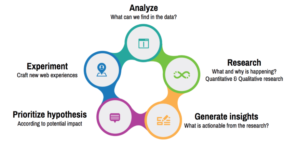
(image source: run-healthy-conversion-rate-optimization-process)
Examples of conversions
Before getting into tactics, it’s important to understand what conversions are. We can identify two main categories of conversions: macro and micro.
Macro-conversions include multiple steps and are part of a longer process, for example:
- Purchasing a product
- Requesting a quote
Micro-conversions are smaller, often one-step actions like:
- Signing up to a mailing list
- Adding a product to the cart
How do you measure conversion rate?
A conversion rate can be calculated dividing the number of conversions by the total number of visitors and multiplying the result by 100 to get a percentage.
Conversion rate = (conversions / total visitors) * 100%
So if you had a form where 400 people viewed the form, but only 20 filled it in, your conversion rate would be:
Conversion rate = (20/400) x 100 = 5%
In terms of benchmarks these can vary across industries, so it’s important that you use your own data as a starting point and look to improve on that.
And always remember to put numbers into context – if you have 3 views on a page and 1 person converts, that’s a conversion rate of 30%! But you only had 3 views. So it’s always helpful to put your converse rate into context with the total amount of traffic and views the target page is getting.
How CRO helps your e-commerce SEO
Applying conversion rate practices not only improves your conversions, but it will also have a positive effect on your e-commerce SEO.
Customer insights & improved user experience
One of the main skills in SEO is to better understand how your customers think, and how they will search for your products and navigate across your website. By using CRO tactics, you can A/B test keywords, call to actions, page layouts as well as directly ask your customers for feedback in surveys or forms.
On top of this, as you are optimising your web pages for users based on their positive feedback, you are providing your customers with a better user experience. This will encourage longer times on page, improved click-through-rates and lower bounce rates, which are all considered potential ranking factors. So by improving your users’ experience, you will also improve your capacity to rank better in Google.
Better sales and ROI
As the main goal of CRO is to increase your conversions, this is often directly tied to your sales. By A/B testing various layouts, call to actions, forms and page designs, you will be continually optimising your content to encourage users to convert. This means that you’ll be seeing improvements in sales every time an A/B test gives good results.
CRO also requires a much smaller investment than PPC or sponsored social media campaigns. You generally need one person who’s responsible for setting up the tests, monitoring the results and recommending the next set changes, instead of thousands of pounds in media budgets to be spent on Google. And the results can be very rewarding. In 2020, Venture Harbour increased their conversions by 743% by changing their sign-up forms from one step to multi-step. And music software company Avid increased their transactions by 34% thanks to the results of A/B testing.
Top conversion rate tactics
Increase your conversions with A/B Testing
The number one tactic in CRO is to A/B test wherever possible, so you can compare results between one layout and another. Otherwise it will be hard to see which changes are leading to better performance.
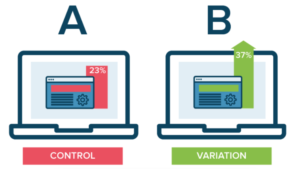
(Image source: https://www.optimizely.com/optimization-glossary/ab-testing/)
It is recommended to make the most obvious changes first, for example changing the position of a call to action, or the number of fields in a form, in order to get quick wins from the get go. Then over time you can A/B test smaller changes.
Data is your most powerful asset
In order to make decisions on what should be rolled out, you must look at the data. Main metrics will include impressions, clicks, form fills, bounce rates, time on page and of course, conversion rates.
Data should not only be used for evaluating the results of your tests, but also to identify which pages you should be optimising in the first place. You should focus your efforts on high value, high traffic pages that are important to the business. It’s important to make changes on pages that receive lots of traffic, otherwise you won’t get enough feedback and interactions to make informed decisions.
There are many tools you can use to measure the data, which we’ll look at further on, but for actual page selection, Google Analytics and Google Search Console will be your best sources to identify your high traffic pages.
Don’t use hunches or gut feelings
The cardinal sin of CRO is making decisions based on a hunch or a gut feeling. Hypotheses about what to A/B test can come from a subjective place or by looking at competitor websites, but when it comes to deciding what to actually roll out, this should always come from the data.
The whole purpose of CRO is to set up tests, gather data and see what works best. Based on those results, you should then implement changes and carry on testing. Deciding to change your web page layout because it ‘looks nicer’ one way has no basis in data, and so should not be your deciding factor. Use the results of your tests as you can be sure these will bring the best results.
Best conversion rate optimisation tools
There’s a range of free and paid tools that can be used for CRO. Some you will be familiar with and some you may not, but whatever the scale and the budget, there’s a toll available.
Quantitative vs. Qualitative Data
When it comes to setting up your tests, there’s two types of data you can collect. The first is quantitative: this is statistical data and structured in nature. It answers the questions ‘how much or how many’. For example this would be the number of visits on a page, the average bounce rate, the average time in seconds that a user spends on a page. This can be obtained through data analysis tools like Google Analytics or Adobe Analytics.
The second type of data is qualitative: this is non-statistical and unstructured data. This answers the question ‘why’. This can be obtained by using heat maps tools to see where users navigate to on your pages, having pop-up boxes that ask for user feedback, and sending out questionnaires’ or surveys to get honest feedback about a user’s experience with your page.
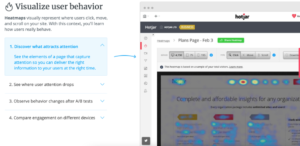
(Image source: https://www.hotjar.com/tour/#heatmaps)
Although you can make decisions and set up tests with just quantitative data, the combination of both is the gold standard.
Free tools vs. Paid tools
So how do you find the tools to do all of this? Well as mentioned previously, some are well known, and free like Google Analytics and Adobe Analytics, which give great insights on traffic patterns, traffic sources, and common quantitative data around number of sessions, session duration, where users enter and exit as well as user flow and journeys.
Then there are more specialised tools like HotJar and Crazy Egg which offer heat maps and great visual insights on user behaviour. As well as Google Optimise which is an experiment and testing platform which integrates with Google Analytics.
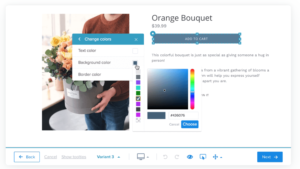
(Image source: https://www.crazyegg.com/ecommerce)
Most of the tools offer free trials if you want to run tests on a smaller scale, but if you want to run tests and develop CRO at scale, it’s advised to invest in one of the paid tools to manage your experiments in a purpose built platform.
So there we have it – the wonderful world of CRO. If you do have any questions or would like to discuss a conversion rate implementation strategy with one of our team, just get in touch and we’d be happy to help.
Contact our Wakefield based team on 0800 234 3977
Struggling to Get Your Site Ranking? Get in Touch. Need Help Boosting Your Authority? Read on...